
Pain management remains a significant challenge in clinical medicine, especially as the opioid crisis underscores the need for safer alternatives. Voltage-gated sodium channels (NaV) play a crucial role in pain signaling, with NaV1.8 being a key contributor in peripheral sensory neurons. Suzetrigine (VX-548), recently FDA-approved as Journavx™, is a highly selective NaV1.8 inhibitor that offers a novel non-opioid approach for moderate to severe pain. Unlike traditional sodium channel blockers that inhibit ion conduction, suzetrigine binds to the voltage-sensing domain 2 (VSD2) of NaV1.8, stabilizing the closed state via an allosteric mechanism effectively preventing action potential propagation and pain signal transmission.
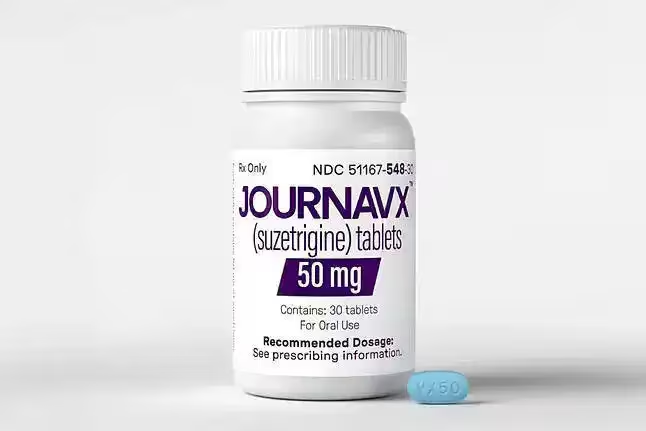
Suzetrigine’s mechanism ensures highly selective inhibition of NaV1.8, with over 31,000-fold selectivity compared to other NaV subtypes, minimizing off-target effects. Unlike conventional sodium channel blockers that require channel opening, suzetrigine exerts tonic inhibition independent of action potential frequency, maintaining effectiveness across varying neuronal firing rates. This allosteric approach enhances its therapeutic potential while reducing the risk of broad sodium channel blockade-related side effects.
In Phase 3 trials involving 2,447 patients with moderate to severe pain, suzetrigine provided significant pain relief, matching opioid efficacy without associated risks. Suzetrigine avoids CNS effects, reducing risks of sedation, cognitive impairment, and addiction. It also lacks cardiovascular or respiratory toxicity and does not cause dependence or withdrawal. The most common adverse effect was dizziness (3.8%), occurring less frequently than with placebo (6.4%) or opioids (5.3%).
Read more on the FDA News Release.




Leave a Reply