
• Albumin

    Albumin

    Albumin is the most abundant globular plasma protein, an important transport protein, and the primary determinant of oncotic pressure (the colloid osmotic pressure that opposes hydrostatic pressure in determining transcapillary flow). The colloid versus crystalloid debate is a timeless point of contention in acute care medicine, but the general teaching…

    Read More

  • ClearFast

    ClearFast

    The “NPO guidelines” (ie, 8 hours for full meals, 6 hours for light meals, 2 hours for clear liquids) have varying degrees of “evidence”, but for the most part, patients are told to “eat or drink nothing after midnight.” In my opinion, they are just that – GUIDELINES. I think…

    Read More

  • Lactated Ringer’s

    Lactated Ringer’s

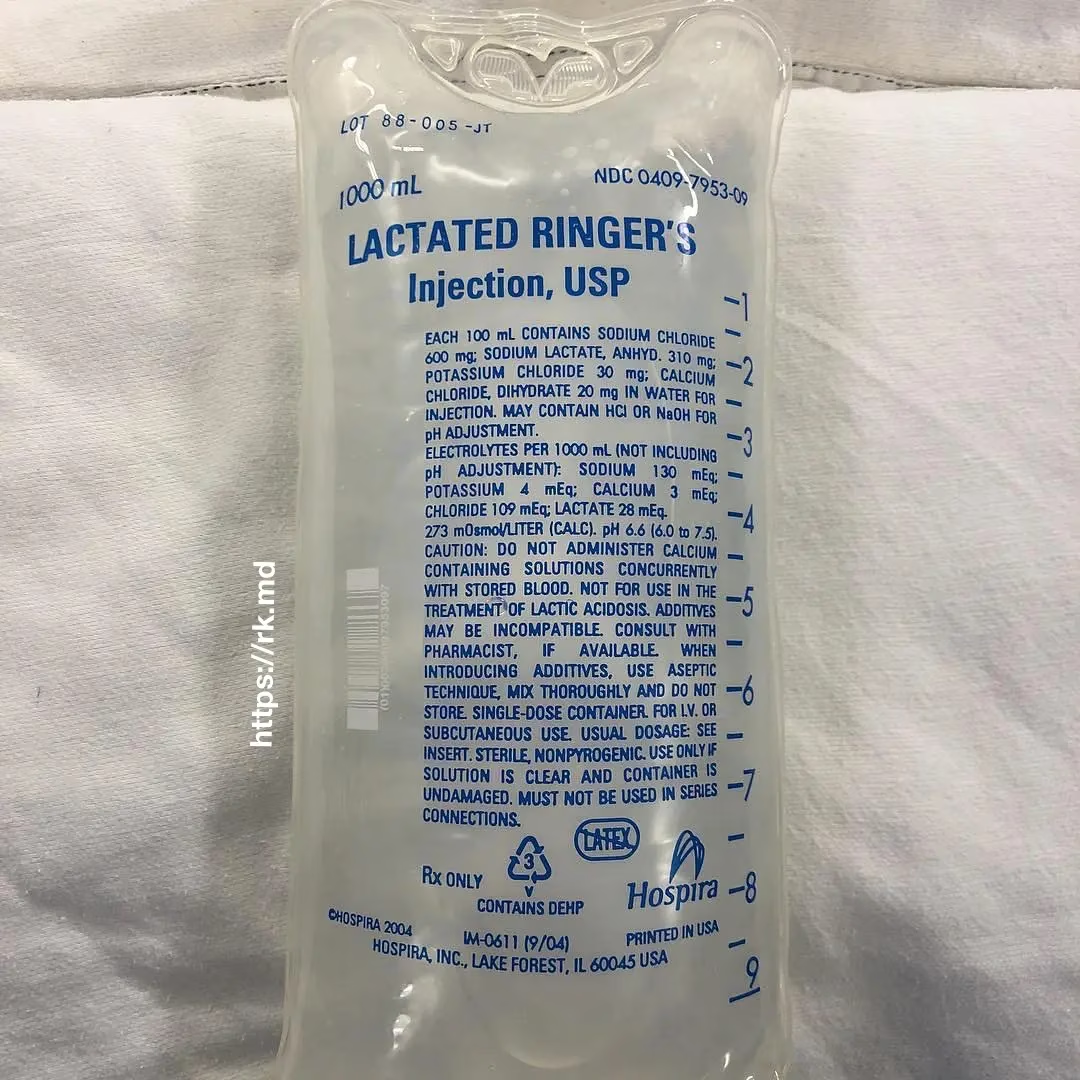
    Lactated Ringer’s (LR) is a balanced crystalloid solution created by Dr. Sydney Ringer in the 1880s using ex-vivo frog hearts. It contains sodium, chloride, lactate, potassium, and calcium, yielding an osmolarity of 273 mOsm/L (human plasma is ~ 290 mOsm/L). In the OR and ICU, I preferentially use balanced crystalloids…

    Read More

  • Normal Saline

    Normal Saline

    Normal saline (NS) is one of the most widely used therapies in medicine. One liter of solution contains 154 mEq of sodium and 154 mEq of chloride with a pH ~ 5.5. The fact that the solution is acidic is actually UNRELATED to how it CAUSES non-anion gap acidosis in…

    Read More

  • Starling Equation – Hydrostatic and Oncotic Pressures

    Starling Equation – Hydrostatic and Oncotic Pressures

    “Starling forces” describe the movement across capillaries as a balance between hydrostatic and oncotic pressure gradients within the capillary and surrounding interstitium. Filtration across the capillary membrane occurs along its entire length and is based on a net driving pressure gradient.

    Read More

  • Intraoperative Fluid Management Plans

    Intraoperative Fluid Management Plans

    This topic was actually brought up by a medical student who worked with me last week in the operating room. After seeing a unit of packed red blood cells hanging alongside a liter of normal saline on the IV pole, he asked how anesthesiologists know how much fluid to give…

    Read More

  • Placing A Peripheral Intravenous (PIV) Catheter

    Placing A Peripheral Intravenous (PIV) Catheter

    Peripheral intravenous (IV) access is utilized for volume resuscitation, medication administration, blood product transfusion, nutrition, lab draws, and many other reasons. It’s a skill which anesthesiologists perfect through experience but often poses a challenge to new trainees. Let’s discuss the basic set up and some tips.

    Read More