• How Much PEEP?

    How Much PEEP?

    Positive end-expiratory pressure (PEEP) is routinely utilized during mechanical ventilation to improve alveolar recruitment and combat cyclic trauma from repeated deflation/expansion of the alveolar unit which can lead to stimulate the inflammatory cascade (“atelectrauma”). As a cardiac anesthesiologist, most of my patients’ respiratory mechanics are affected during and immediately after…

    Read More

  • Treprostinil

    Treprostinil

    Treprostinil (Remodulin) is an IV, SC, PO, and inhaled prostaglandin I2 analog used to treat pulmonary arterial hypertension (PAH) by causing vasodilation. Like other medications in this class, one must be wary about compounding systemic vasodilatory effects and platelet inhibition with other anti-hypertensives and anticoagulants, respectively. The subcutaneous administration of…

    Read More

  • Chylothorax

    Chylothorax

    The thoracic duct is the primary conduit which carries chyle (lymphatic fluid containing triglycerides, immune cells, proteins, etc.) from the cisterna chyli to the subclavian-jugular vein junction where it empties into the circulatory system. If this duct is disrupted through traumatic (ie, cardiothoracic surgery) or nontraumatic (ie, malignancies like lymphoma)…

    Read More

  • How Chest Tube Drainage Systems Work

    How Chest Tube Drainage Systems Work

    Although small amounts of air and fluid in the pleural space are generally well tolerated, pneumothorax, hemothorax, chylothorax, etc., necessitate chest tube placement. Smaller bore tubes can often be utilized and placed more apically for large air collections as air rises. Viscous fluid collections (complicated effusions, hemothorax, empyema, etc.) often…

    Read More

  • Positive End Expiratory Pressure (PEEP) and Cardiac Output

    Positive End Expiratory Pressure (PEEP) and Cardiac Output

    One of the cardiopulmonary challenges I constantly face as a cardiothoracic anesthesiologist and intensivist is balancing positive end-expiratory pressure (PEEP) with cardiac output (CO). CO is related to the heart rate (HR) and stroke volume (SV), the latter of which is related to preload, afterload, ventricular compliance, and contractility. Although…

    Read More

  • Albuterol

    Albuterol

    Albuterol (ProAirVentolin/Proventil) is most often used as a short-acting, inhaled therapy for bronchospasm. It works via β-2 agonism – adrenergic receptors that relax bronchial smooth muscle through cyclic AMP-mediated signaling. Levoalbuterol (Xopenex) is the active enantiomer of albuterol and confers better β-2 selectivity to avoid β-1 effects like tachycardia.

    Read More

  • The ‘Q’ In “V/Q Mismatch”

    The ‘Q’ In “V/Q Mismatch”

    You can’t read about pulmonary physiology without encountering the topic of V/Q mismatch, otherwise known as ventilation-perfusion mismatch. In fact, of the five major etiologies of hypoxemia, V/Q mismatch is the most common!

    Read More

  • Reexpansion Pulmonary Edema

    Reexpansion Pulmonary Edema

    Reexpansion pulmonary edema (RPE) is a rare but potentially life-threatening condition that occurs when the lung is rapidly expanded following compression due to air (pneumothorax) or fluid (pleural effusion). Although the underlying pathophysiology is poorly understood, it is attributed to increased alveolar-capillary membrane permeability, reperfusion injury, and even surfactant dysfunction.…

    Read More

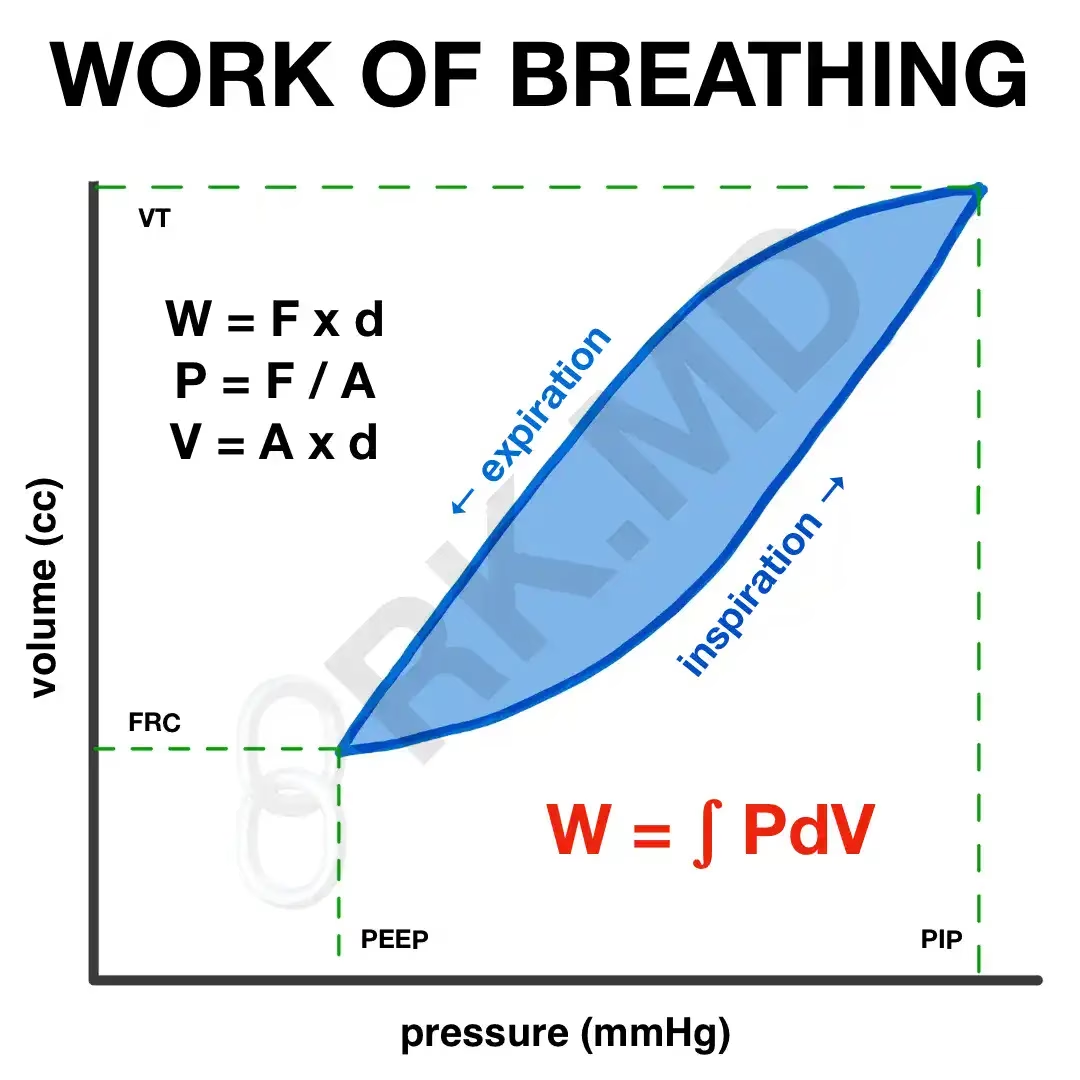
  • Work Of Breathing – Pressure-Volume Curve Integration
  • Ultrasound Pleural Effusion And Spine Sign

    Ultrasound Pleural Effusion And Spine Sign

    In this ultrasound still image, I have a phase array probe positioned on the left side of the body around the 8th rib. A left-sided pleural effusion is noted. It’s important to appreciate this view to look for free fluid in the subphrenic and splenorenal spaces. The green arrow denotes…

    Read More