• Candida Auris (C. auris)

    Candida Auris (C. auris)

    Candida auris (C. auris) has become a significant challenge in critical care across the country. It spreads across surfaces, equipment, and even skin, allowing outbreaks to take hold long before they are detected. These infections tend to appear in patients with comorbidities like advanced age, diabetes, kidney disease, malignancy, dialysis…

    Read More

  • I Hate Tramadol

    I Hate Tramadol

    Tramadol (Ultram) is often prescribed for analgesia because it’s easy to write for (especially at hospital discharge); however, its pharmacology makes it unreliable for pain control. The parent compound has only weak affinity for the mu opioid receptor, so most of the meaningful opioid effect comes from its active metabolite…

    Read More

  • STS Short-Term Operative Risk Scoring System

    STS Short-Term Operative Risk Scoring System

    As with any procedure, cardiac surgery carries risks that are explained to patients by their surgical team. The Society of Thoracic Surgeons Short-Term Operative Risk Calculator provides clinicians with a way to anchor these discussions. It uses data from hundreds of thousands of cardiac operations to estimate the chance of…

    Read More

  • Gerbode Defect

    Gerbode Defect

    Gerbode defects create an abnormal communication between the high-pressure left ventricle (LV) and the right atrium (RA), thereby completely bypassing the right ventricle. That pathway sets up a distinctive left-to-right shunt with hemodynamics that can be subtle or profoundly destabilizing, depending on the size of the communication and the clinical…

    Read More

  • NxStage System One CRRT Display

    NxStage System One CRRT Display

    The NxStage System One continuous renal replacement therapy (CRRT) system provides convective and diffusive clearance through a simplified cartridge system. It has an interface centered on three large, color-coded numeric fields that offer the most essential information for therapy. When I’m rounding in the CVICU, I often look at these…

    Read More

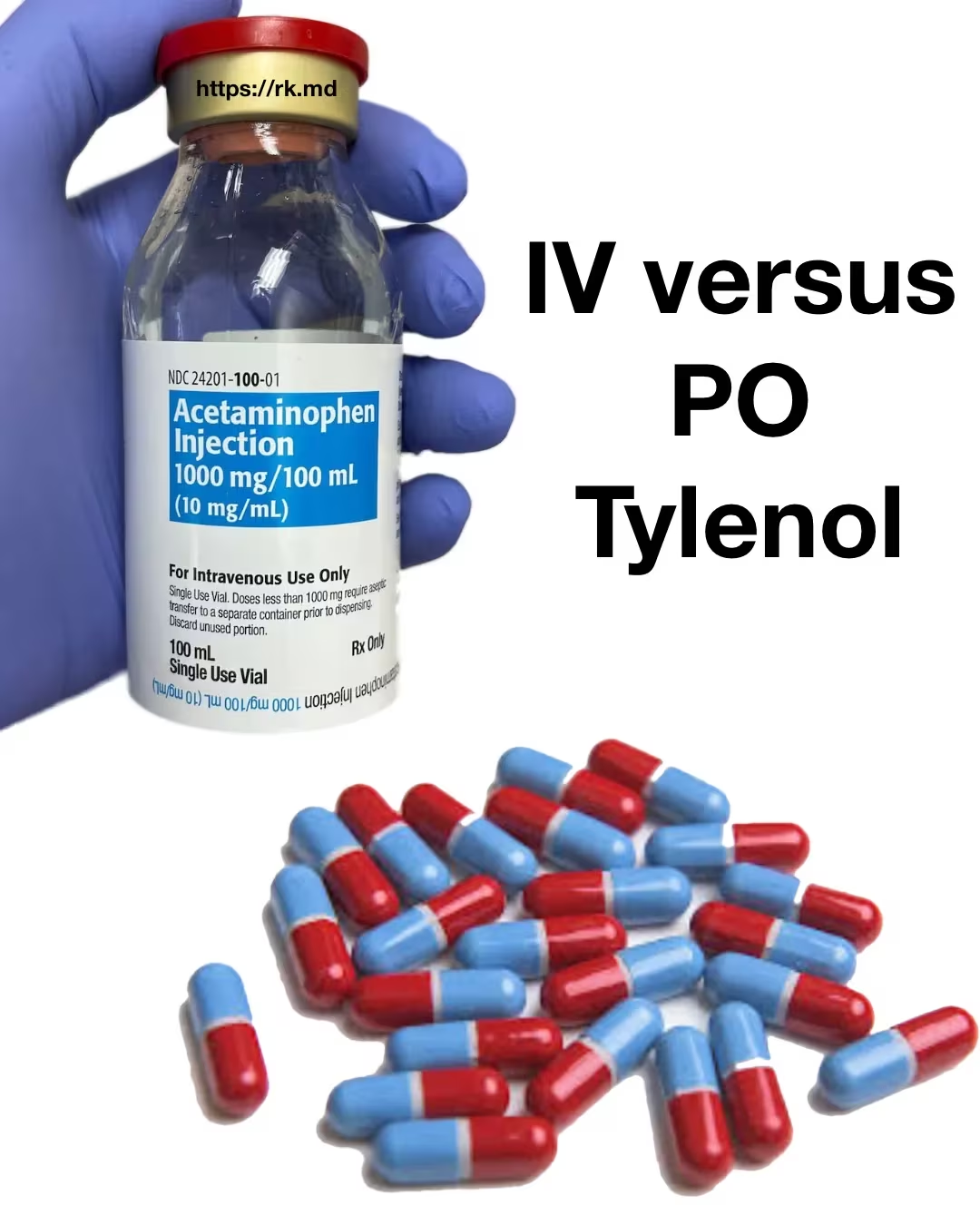
  • IV Versus PO Acetaminophen (Tylenol)

    IV Versus PO Acetaminophen (Tylenol)

    Acetaminophen (Tylenol) is routinely administered in IV and PO (pill) forms in perioperative and critical care medicine, but the debate of which route of administration is superior comes up all the time, despite the evidence being consistent for years. TLDR – once both formulations are absorbed, the analgesic effect is…

    Read More

  • Isopropyl Alcohol (IPA) Aromatherapy for Nausea Relief

    Isopropyl Alcohol (IPA) Aromatherapy for Nausea Relief

    Isopropyl alcohol (IPA) aromatherapy by means of inhaling the vapors from an IPA pad has been a simple bedside practice used to relieve nausea. Several studies suggest that IPA inhalation can provide a quick, modest reduction in nausea severity in an inexpensive, safe, and easy-to-administer intervention. However, other trials and…

    Read More

  • Hydroxocobalamin vs. Methylene Blue for Vasoplegia After Cardiac Surgery

    Hydroxocobalamin vs. Methylene Blue for Vasoplegia After Cardiac Surgery

    As a cardiac anesthesiologist and intensivist, vasoplegia following cardiopulmonary bypass is an issue I often face in the OR and ICU. This distributive shock phenotype is characterized by low systemic vascular resistance, despite preserved or elevated cardiac output, primarily driven by dysregulated nitric oxide (NO) and guanylate cyclase signaling, which…

    Read More

  • Aldosterone Escape

    Aldosterone Escape

    Aldosterone escape is the phenomenon where, despite persistently elevated aldosterone levels (endogenous or exogenous), the body prevents unchecked sodium retention and volume overload. After an initial period of sodium retention, renal compensatory mechanisms “escape” from aldosterone’s effects. This is clinically relevant in conditions like primary hyperaldosteronism (Conn’s syndrome), patients on chronic…

    Read More

  • Eutectic Mixture Of Local Anesthetics (EMLA)

    Eutectic Mixture Of Local Anesthetics (EMLA)

    A eutectic mixture refers to a combination of two or more substances that, when mixed in a specific ratio, form a mixture with a lower melting point than any of the individual components alone. As a cardiac anesthesiologist and intensivist, I occasionally use a eutectic mixture of local anesthetics (EMLA)…

    Read More