• Expanding Neck Hematoma Management

    Expanding Neck Hematoma Management

    Neck hematomas are a life threatening albeit rare post operative complication of surgeries in the cervical spine and neck (thyroidectomy, carotid endarterectomy, etc.) The overwhelming majority of patients who undergo these types of surgeries recover in the post-anesthesia care unit (PACU) and go home after meeting discharge criteria. 

    Read More

  • Oxyhemoglobin Dissociation Curve

    Oxyhemoglobin Dissociation Curve

    The oxyhemoglobin dissociation curve (ODC) is one of the most recognized teachings of basic physiology. It describes the relationship between the saturation of hemoglobin and the partial pressure of arterial oxygen. Intuitively, it makes sense that the more oxygen available (a higher PO2), the more saturated hemoglobin will be (% saturation). But…

    Read More

  • PaCO2 Equation

    PaCO2 Equation

    I’ve previously written about the alveolar gas equation and oxygen delivery equation, both of which deal with the physiologic process of oxygenation. Now I want to discuss the important relationship between alveolar ventilation (VA), carbon dioxide production (VCO2), and alveolar carbon dioxide tension (PACO2). For this explanation, PACO2 roughly approximates arterial…

    Read More

  • Alveolar Gas Equation

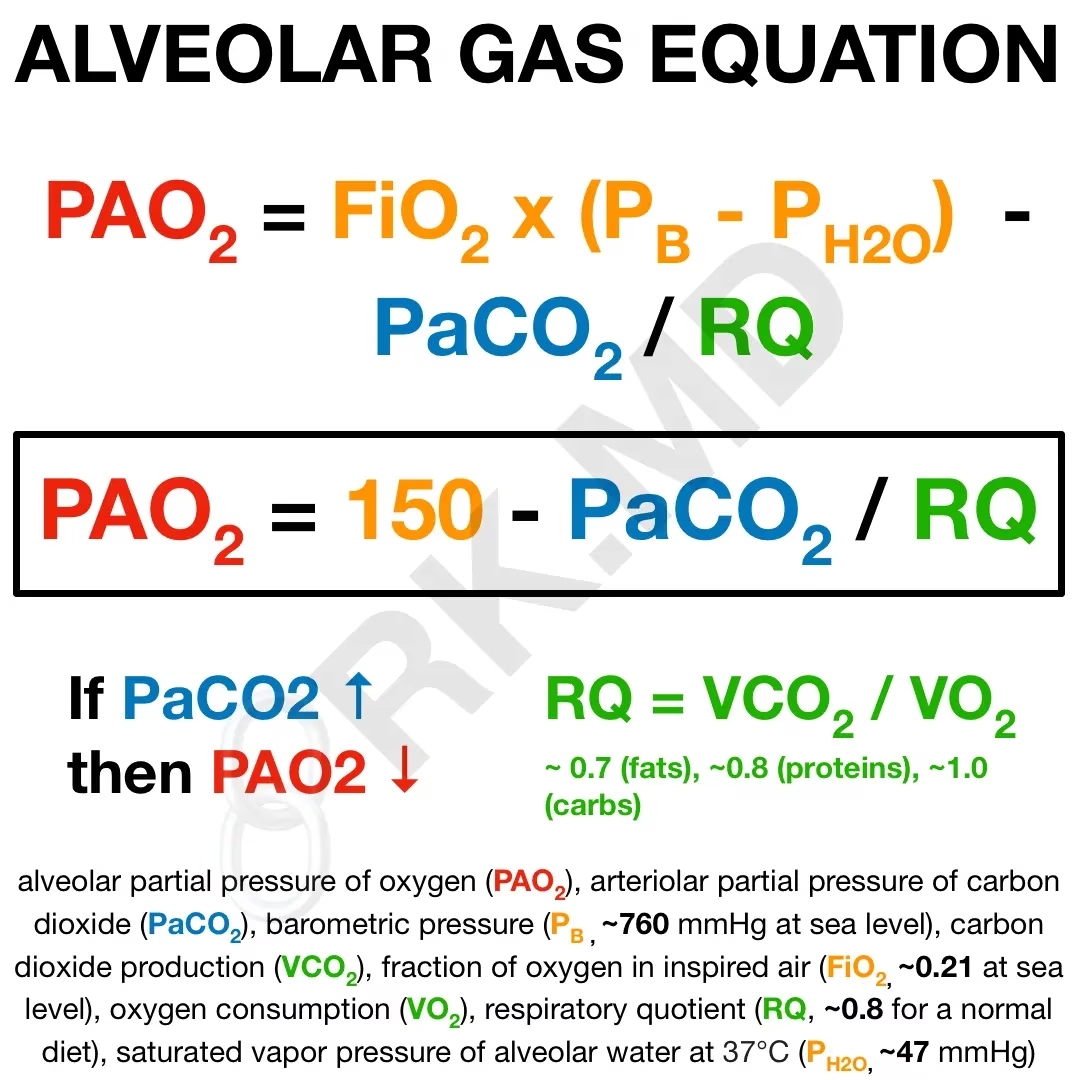
    Alveolar Gas Equation

    I previously wrote about the oxygen delivery equation mathematically describing a vital concept in physiology. Now I want to discuss another critically important formula in acute care medicine – the alveolar gas equation.

    Read More

  • Awake Fiberoptic Intubation

    Awake Fiberoptic Intubation

    This month has been riddled with challenging airway situations, so I thought it would be a great opportunity to discuss how I perform awake fiberoptic intubations. The decision to intubate someone awake is rooted in the high likelihood that the patient will be a “difficult airway” for whatever reason. Keeping the…

    Read More

  • Oxygen Delivery Equation (DO2)

    Oxygen Delivery Equation (DO2)

    The arterial oxygen delivery (DO2) equation is undeniably one of the most essential physiologic principles. DO2 is comprised of two variables: It’s crucial to consider acute changes (e.g., hemorrhage and desaturation) in the context of this equation. As shown, hemoglobin concentration and the oxygen saturation of that hemoglobin are the most…

    Read More

  • Frank-Starling Law

    Frank-Starling Law

    The Frank-Starling law of the heart is one of the most important intrinsic properties of cardiac muscle. It states that a change in venous return (preload) confers a change in the force of cardiac contraction (stroke volume or cardiac output) through increased sarcomere lengthening and excitation-contraction coupling of the muscle fibers.

    Read More

  • Vasopressin

    Vasopressin

    Vasopressin, otherwise known as antidiuretic hormone (ADH), is a peptide hormone synthesized in the hypothalamus and released by the posterior pituitary gland. Its physiologic effects include vascular smooth muscle constriction (via V1 receptors, PLC-IP3 and calcium pathway) and free water retention (via V2 receptors, cAMP/PKA pathway).

    Read More

  • Reinforced Endotracheal Tubes

    Reinforced Endotracheal Tubes

    When I first started my anesthesiology training, I almost always used a reinforced endotracheal tube (ETT) for cases where my patient would be positioned prone for an extended period of time. One can imagine that in this position, even if the head is situated in a “prone pillow”, there’s a higher likelihood of…

    Read More

  • What Does Gtt Mean?

    What Does Gtt Mean?

    Medical jargon is riddled with abbreviations, many of which are universally understood and some of which are very specialized. Yes, I’m looking at you, ophthalmology and OB/GYN. 😛

    Read More